
Artificial Intelligence in universities: data stays on campus
Find out how Inforlandia, through its INSYS workstations with pre-configured AI, provides higher education institutions with an on-premises, secure and production-ready AI infrastructure.
The challenge: making the most of AI without losing control of the data
Universities deal with large volumes of information and documentation on a daily basis: regulations, accreditation processes, reports, application dossiers, decisions and academic procedures.
These are documents that require analysis, cross-referencing of information and the ability to respond. At the same time, academic and administrative departments need to respond quickly to simple, frequently asked questions.
Artificial Intelligence can transform these tasks, boosting productivity and facilitating access to information. But there is one fundamental condition: the data must remain under the institution’s control.
The use of AI models hosted on public cloud platforms raises issues of data sovereignty, privacy and compliance with the GDPR. For many universities, this is a barrier to the widespread adoption of these technologies.
On the other hand, installing and configuring an AI infrastructure in-house requires technical expertise, time and specialised resources.
The solution lies in providing a local AI infrastructure – ready-to-use and validated – that enables institutions to utilise these technologies without having to build and manage all their technical complexity.
The solution: ready-to-use, on-premises AI powered by INSYS technology
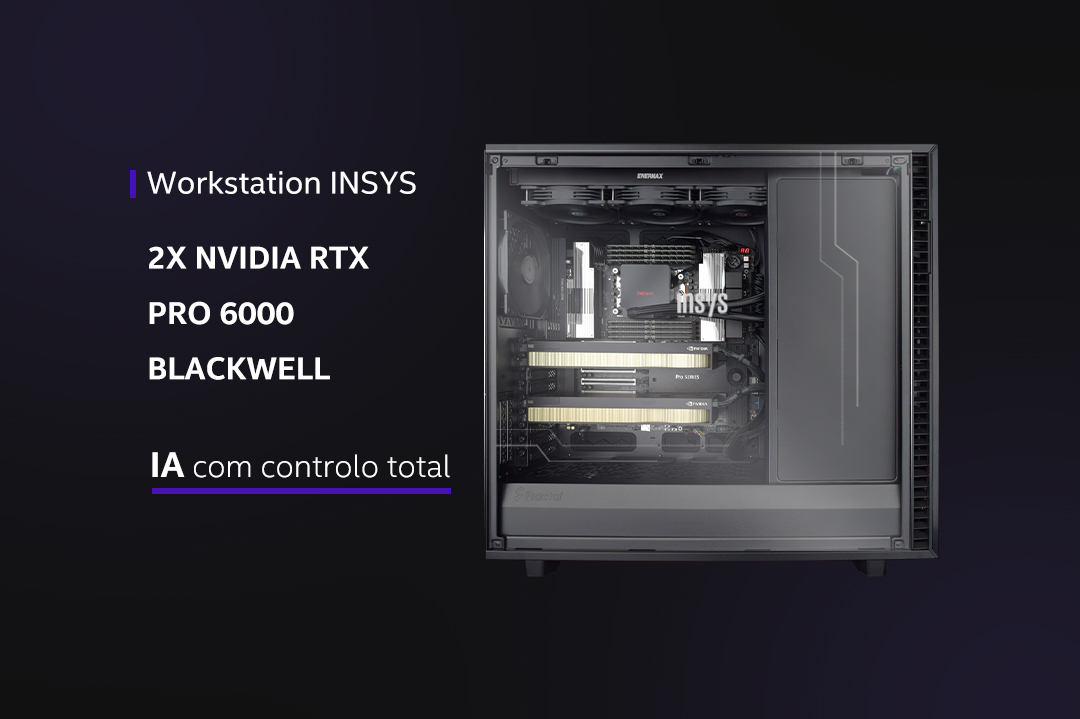
Inforlandia has developed and validated a solution based on an INSYS workstation equipped with two NVIDIA RTX PRO 6000 Blackwell graphics cards, featuring pre-configured artificial intelligence models tailored to different usage requirements.
Rather than simply supplying high-performance hardware, Inforlandia delivers an integrated solution, with the models, runtime environment and necessary services already configured.
The aim is to simplify implementation: the organisation receives an infrastructure ready to provide AI services in-house, without having to start from scratch when selecting and configuring the technological components.
Two AI models, two complementary needs
The configuration has been designed to cater for two types of use that are particularly relevant in a university context:
1. Analysis of lengthy documents and more complex tasks
The Qwen3.8-Flash-Next model utilises one of the GPUs and provides a context window of up to 262K tokens.
This capability allows users to work with extensive documentation, such as regulations, accreditation dossiers, application processes and sets of related documents.
Measured performance: approximately 135 tokens per second in a single session.
2. Simultaneous response to multiple users
The Qwen3.8-27B NVFP4 model utilises the second GPU, operating as a standalone service.
It is designed for concurrent usage scenarios, in which several staff members access the AI simultaneously.
Measured performance:
Approximately 88–89 tokens per second in a single session.
Between 780 and 940 tokens per second of aggregate generation across the measured workload suites.
This architecture allows for the separation of two types of usage, rather than simply seeking to double the speed of a single model.
The result: an AI infrastructure under the university’s control
With this solution, institutions can make AI tools available to their academic and administrative departments, whilst keeping processes and documentation within their own technological environment.
Key applications include:
Document analysis: searching and analysing regulations, annexes, resolutions and complete case files.
Decision support: preparing information and assisting with the drafting of opinions and documents.
Academic services: rapid responses to frequently asked questions about procedures, deadlines and documentation.
Administrative productivity: support for researching, summarising and drafting information.
Concurrent use: making the service available to multiple staff members, including during periods of peak usage.
Naturally, AI functions as a support tool. Human validation remains essential for decisions and the documents produced.
A solution already in use at Portuguese universities
This configuration is not merely the result of a theoretical exercise or an isolated pilot project.
Inforlandia has already delivered and configured various Artificial Intelligence models within infrastructures of this nature for Portuguese universities.
The experience gained from these implementations confirms the importance of an approach in which processing capacity, ease of use and, above all, data sovereignty are considered as a whole.
Academic processes, application files and regulations remain within the institution’s own technological environment, enabling the provision of Artificial Intelligence services without having to send this content to public models in the cloud.
The university does not need to build an AI laboratory. It needs a ready-to-use solution.
This is what Inforlandia offers with its INSYS Artificial Intelligence workstations and servers: high-performance technology, pre-configured and tailored to the real needs of organisations.